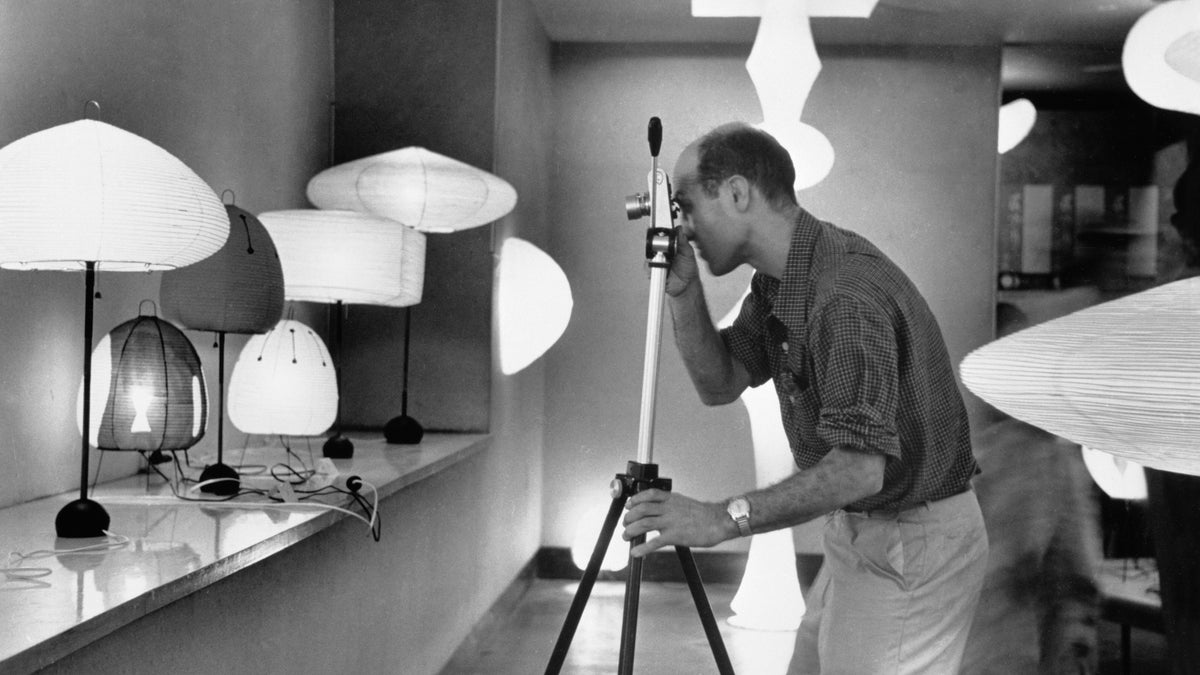
Isamu Noguchi photographing “Isamu Noguchi Exhibition,” Chuo Koron Gallery, Tokyo, August 2–7, 1954. The Noguchi Museum Archives, 07020. ©INFGM / ARS

Akari Ceiling Lamps

    About Akari Light Sculptures
    Akari light sculptures are a luminous series of works created by the artist Isamu Noguchi beginning in 1951. Noguchi worked on Akari for thirty-seven years, nearly half of his life, and designed over 200 models. He described them as, “the one thing that I’ve done out of pure love.”
    Isamu Noguchi working on paper template for Akari, c. 1951–52. The Noguchi Museum Archives, 03602. ©INFGM / ARS
    About Akari Light Sculptures
    The shades of Akari are handmade of mulberry bark washi paper and bamboo by Ozeki & Co., a family-owned company, founded in 1891 and based in Gifu, Japan. Though their finished forms “may be moved with a thought,” their construction reflects generations of craftsmanship.
    Isamu Noguchi and employees at Ozeki & Co. with Akari, c. 1978. The Noguchi Museum Archives, 142353. ©INFGM / ARS
    About Akari Light Sculptures
    Many Akari shades begin with thin strips of bamboo ribbing (higo). Smaller pieces of higo are tied together with white cotton string to create a long, continuous strand. The strand is then wrapped around notches in bespoke wooden construction molds made for each model.
    Isamu Noguchi and employee at Ozeki & Co. with Akari, c. 1968. Photo: Michio Noguchi. The Noguchi Museum Archives, 03622. ©INFGM / ARS
    About Akari Light Sculptures
    After the ribbing is placed, rice glue is applied to the construction mold with a brush. Panels of mulberry bark washi paper are carefully pressed onto the mold and trimmed to size. After drying in a specially heated room, the mold is collapsed and removed from the inside, and the shade folds flat for efficient packaging and shipping.
    Employee at Ozeki & Co. making Akari, c. 1978. Photo: Michio Noguchi. The Noguchi Museum Archives, 03640. ©INFGM / ARS
    About Akari Light Sculptures
    From Noguchi’s mind, to craftspeople’s hands, and, finally, in people’s homes, Akari light sculptures dissolve the boundary between function and art. Assessing the series near the end of his career, Noguchi wrote, “They seem to offer a magical unfolding away from the material world.” Or, as he was fond of saying, “All that you require to start a home are a room, a tatami, and Akari.”
    Isamu Noguchi’s home in Mure, Japan. Photo: Michio Noguchi. The Noguchi Museum Archives, 06163. ©INFGM / ARS
Isamu Noguchi making a styrofoam model for Akari, c. 1968. The Noguchi Museum Archives, 06939. ©INFGM / ARS
Fig. 1
Isamu Noguchi making a styrofoam model for Akari, c. 1968. The Noguchi Museum Archives, 06938. ©INFGM / ARS
Fig. 2
Isamu Noguchi making a styrofoam model for Akari, with form resembling unfinished 24N, c. 1968. The Noguchi Museum Archives, 06941. ©INFGM / ARS
Fig. 3
Fig. 1–2 Isamu Noguchi making a styrofoam model for Akari, with forms resembling 20N and 22N, c. 1968. Fig. 3 Noguchi making a styrofoam model for Akari, with form resembling unfinished 24N, c. 1968. The Noguchi Museum Archives, 06938, 06939. 06941. ©INFGM / ARS
Isamu Noguchi: What is Sculpture?, Venice Biennale, June 29–September 28, 1986. The Noguchi Museum Archives, 144387. ©INFGM / ARS
Installation view, “Isamu Noguchi and Hiroshi Teshigahara,” Sogetsu Kaikan, November 20–December 20, 1980. The Noguchi Museum Archives, 03018. ©INFGM / ARS
A Grid of “Enban” in Tokyo
The Akari 50EN, 70EN, and 95EN share the acronym EN, identified in ephemera from The Noguchi Museum Archives as short for the Japanese word enban, meaning saucer or discus. The 50EN was installed in a dense grid over biomorphic ceramics for Isamu Noguchi and Hiroshi Teshigahara, held at Tokyo’s Sogetsu Kaikan, the famed ikebana school, in 1980.
Installation view, Isamu Noguchi and Hiroshi Teshigahara, Sogetsu Kaikan, November 20–December 20, 1980. The Noguchi Museum Archives, 03018. ©INFGM / ARS